Nose Submerged Inlet Door

I have decided to depart from the plans regarding oil cooler location and cabin heat.  I plan to put the oil cooler in the rear of the aircraft, and use the nose NACA inlet for cabin fresh air only.  Details, calculations, and full plans to follow later. To control the amount of fresh air entering the aircraft, I am building an electrically actuated door that will fit flush in the NACA inlet when closed, sealing it completely against incoming air, and also retaining the fuselage contour. When open, outside air will be routed to cabin ducts for cooling in the hot Texas summer.  In the winter, and at altitude, the nose NACA duct will be closed, and hot air from exhaust muffs will be mixed with outside air and routed from the engine compartment into the same ventilation ducts.

Fuel Sump Tank Completion

The sump tank halves were bonded with Jeffco and cured.  The edge lip was sanded down and the entire tank was sanded and coated with 3 coats of epoxy.  Slight pressurization with nitrogen caused the back panel to bow out a little bit, but I did not detect any leaks.  The tank mounting ears were glassed onto the sides of the tank, and after curing, were trimmed. Finally, the fittings were screwed into the tank, and the tank was installed against the engine bulkhead below the main spar.

Jacks

I made some hydraulic jack extenders from 4×4, 2×4 legs, and plywood gussets.  The jacks were Harbor Freight specials.  I also laid up some tapered foam parts that fit around the main spar of the aircraft.  A slot was cut in the top layers of glass, and the foam was hollowed out to accept the top of the jack.  This will keep the plane from sliding off the jacks if it gets pushed.

Nose Gear Guides

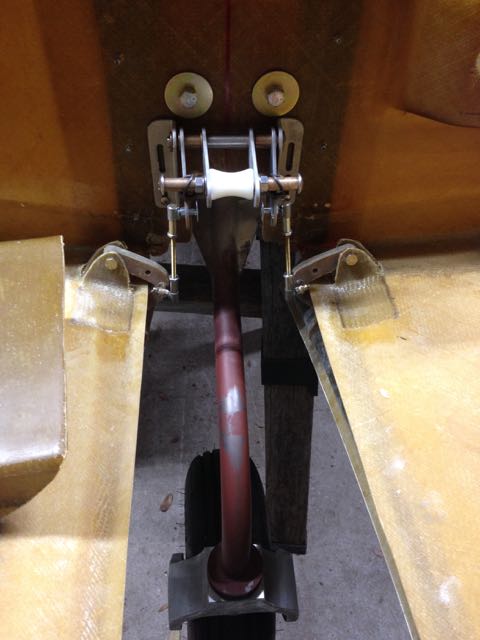
After the guide parts were edge-filled with micro, cured, and sanded, they were tacked into place with hot glue.  Care was taken to make the guides vertical, flush with the door opening, and spaced appropriately from the nose gear axle.  Once tacked into place and clamped, the supports were tacked in place, and then the joints were filleted with cabo and covered with 2x BID.

Sump Tank Inner Flange

An inner flange to assist with joining the two halves of the sump tank was constructed by  making a plywood sheet with a cutout slightly smaller than the opening in the tank.  The inner surface of the plywood was covered with duct tape for release. Working inside the lip of the plywood, 2x BID was laid up inside the tank edge and onto the plywood.

I let this cure a couple of days before trying to remove the plywood sheet.

Nose Landing Gear Guides

Guides were constructed to keep the nose wheel straight as it retracts through the nose gear doors.  This is to ensure that the nose wheel does not catch and hang on the doors or the edges of the nose gear door opening during extension.  That would result in a “bad day” and substantial repairs.  Plans call for making the guides out of a few layers of BID, but I chose instead to make them a little bit beefier, making a composite sandwich with some 3/8″ divinylcell foam.

A big sheet of sandwich was made, then the nose gear guides and supports were cut out with a jigsaw.  Foam was removed from the edges in preparation for some micro.

Sump Tank Construction

The factory supplies the two halves of the sump tank.  Mine had harping pre-installed for the two fuel inlets and the fuel outlet to the engine.  I had to install the hard points for the vent, the sump drain, and the float switch.

The entire inside of the tank was sanded to prepare for sealing and also for the hard points, which were glued in with cabo paste, filleted, and the covered with 2x BID.

Repaired Nose Gear Hydraulic Actuator

After repairing the seals, glands, and O-rings in the nose gear hydraulic actuator, I hooked it up to the nitrogen bottle and tested for leaks in both travel directions.  All secure!  The actuator was installed into the airplane and the nose gear retraction test and dump valve worked flawlessly, holding in the gear-up position for several hours with no noticeable loss of pressure.

Nose Landing Gear Retraction Test- Not

I wanted to test the nose gear retraction system and get the actuator limits set correctly prior to moving on to other things. Instead of hooking up the hydraulic pump and having to potentially chase hydraulic fluid leaks, I decided to use gas.  Yes, there is a stored energy concern compared to using hydraulic fluid, but its still a good first test if I am careful.  I got a nitrogen cylinder and a regulator and hooked it up to retract the nose gear.  The actuator brought the mechanism out of over-center at about 200 psi, and at about 300 psi, the gear quickly sprung all the way up. After closing the nitrogen cylinder valve, the pressure quickly decreased and the gear fell back into the extended position – clearly a leak somewhere.  I got some snoop (soapy water) and started checking fittings but it became pretty clear that the external fittings were not leaking but the actuator cylinder was leaking internally.  This discovery made the test worthwhile.

I removed the nose gear actuator cylinder (PITA) from the keel, disassembled it, and found that the actuator piston o-ring and backer ring were deformed, “rolled”, and torn.  Although the actuator had oil in it, and moved easily, it looked like the piston had been inserted dry during initial assembly.  The end piece o-rings and backers were in good shape, but I will replace them anyway during rebuild.

Nose Landing Gear Hydraulics

I have made the decision to mount the hydraulic pump in the rear of the aircraft, which means that hydraulic lines will need to go no farther forward than the nose landing gear retraction assembly.  This prevents any hydraulic lines from having to traverse the over-center mechanism and eliminates the tight mechanical fit at the canard bulkhead.  Hydraulic lines were made and attached to the nose gear actuator and the dump valve, and the dump valve was mounted to its recess plate.

The nose landing gear door retraction assembly was installed and adjusted for the desired landing gear limits.  I sure don’t like the way the rod ends attach to the door hinges – this is going to have to change.  I also converted to using all-thread for the pull struts instead of the solid standoffs in the kit.  I will trim the standoffs to the proper length when I am finally happy with the door closing adjustments.  I still need to make the nose gear fork guides.  I have noticed that it is easy for the gear to bind either on the doors or in the opening if it is not exactly straight.  Waiting on some 1/4″ divinycell to make the guides.

img_3750