Nose Landing Gear Adjustments

Numerous adjustments were made to the nose landing gear retraction assembly, mainly because I was not happy with some clearances and travel limits of various parts.  First, the rear surface of the over-center gas spring was rubbing on the sharp corner of the linkage bushing retainer plate.  Easily fixed by grinding off the corners of the retainer plate.  Next, the nose gear actuator cylinder was binding on its mounting brackets at about half-travel, putting undue torque on the bottom of the fuselage.  The actuator assembly was removed from the interior of the keel, the brackets were trimmed to eliminate the interference, and the unit was replaced.  Not easy to get to….

The lower hard point for mounting the gas spring was placed where the manual specified, but in this location the shock strut contacts the bottom of the gas spring when the nose landing gear is retracted.  I decided to move the bottom gas strut mounting post aft by one inch.  This necessitated extending the plywood hard point aft.  The old hard point was cut in half and the aft half removed, and then a new plywood hard point was glued in with structural epoxy, filleted with cabo, and then covered with 2x BID.  After this cured, the new hole and countersink for the gas strut post was drilled and the gas strut was installed. There was very little change in the over-center pressure (it was actually increased) after this modification, and now the nose landing gear can retract without mechanical interference all the way to the limits of the actuator cylinder.

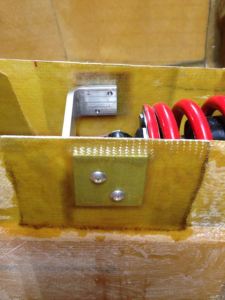
I also beefed up the nose landing gear over-center bracket  attach points with 2″ aluminum hard points glassed in to the keel side wall.  Just in case the actuator travel limits get out of adjustment, it will be harder for the hydraulic system to damage this part of the keel.  Its only thin fiberglass, and looks like it needs reinforcing anyway.
img_3749

Preparation for Viking Annual Inspection

Taking time away from the Velocity to work on the Viking, prepping for annual.  This year, the Vike gets new tires and tubes all around.  After the trip to Canada, there are several new cracks in the finish that have to be addressed.  Old paint and dope were peeled off from those areas.  As usual, it seems like the old original cotton tapes are in decay and this is precipitating the cracks at the longerons and ribs in the horizontal and vertical stabilizers, as well as along the length of the fuselage.

Discovered low compression on cylinder #2, with excessive leakage through the exhaust.  I borescoped the exhaust valve, which looked OK – no evident asymmetry of deposit, warping, or burning on valve or seat.  The cylinder head cover was then removed, and I took off the exhaust rocker and springs.  Discovered I could wiggle the exhaust valve stem about 0.003″ in its seat.  Bad news – worn guide.  Had to pull the jug and send for repair.  This is the second time for this cylinder.  What is going on???

Parts Organization and Seat Hardpoints

The bags of parts I received from the factory are in no apparent order and are poorly marked, if marked at all.  In addition, the part numbers in the manual frequently don’t match up with the part numbers on the part.  This has led to a lot of time searching for a needed part and confusion over whether I am using the right one.  So I decided to go through the manual, match up the parts by function and try, by process of elimination, to associate the hardware with the section of the build manual.  What I found was that I was missing several parts, and that I also had several parts that I could not associate with passages in the manual.

After discussions with Chad at the factory, I learned that there have been a handful of engineering changes to the kit that have made it deviate from the build manual.  For example, the side-stick option eliminates several parts from the kit, but adds many more. There is a small section of the manual for the side-stick option, but there are no photos or drawings to guide assembly or connection.  In addition, the factory is trying to get away from using push-pull cables.  I was given two push-pull cables in my kit, but it turns out that these are superseded by a new design that uses all solid tubes to connect the aileron torque tube bell crank from the aft keel to the aileron bell cranks on the wing.  There are no drawings or documentation for these parts or their assembly…….

All parts were organized, bagged, and labelled, and then stored on a new shelf by the chapter of the build manual.  Some rearrangement of the shop was required to fit the new shelf, and this gave me an opportunity to remove a bunch of wood and metal parts that have been accumulating over the years.  A net win!

With the holidays approaching, and lots of work around the house required to get ready for visitors, I decided to tackle an easy task – the front seat hard points.  First, the aluminum parts were sanded to remove sharp corners and edges.  Surfaces were rough-sanded to promote bonding. A tap was run in the threads to clean out debris, and the parts were washed thoroughly with solvent and wiped dry. Inside layer of fuselage and inner foam was removed on the outside positions, and the inner positions were marked.  All were set and leveled into structural epoxy + flox + cabosil and left to cure. The next day, a fillet of epoxy + cabosil was used to fill and fair around the aluminum, and covered with 2x bid.

Keel penetrations

Landing light opening was cut out using jigsaw and sanded to contour with a flange that will later hold the landing light lens.  The landing light housing (pre-fab part) was cut to fit and sanded, and bonded into place with a mixture of structural epoxy, cabo, and flox.

The NLG access cover was sanded and duct tape was placed around the opening in the keel where the cover will go. The cover was then hot-glued into place, and layers of BID were applied to make a flange.  After curing, the flange was timed and edges sanded smooth.

The circular access hole for the NLG hydraulic cylinder was cut in the keel.  The center was displaced about 1.5″ forward and down from plans due to suggestion from Chad.  The keel outer skin was then cut back and additional 1/2″ with a rabbet router bit.  Foam was dug out in preparation for filling with micro and 2xBID around the edge of the hole.

Preparations

img_3599

Spent a weekend getting the workshop ready to begin fuselage work.  After months spent taking care of other problems around the house, traveling and writing proposals for work, I am finally ready to start working on the Velocity in earnest!

Spent time getting everything organized to make fiberglass layups, mounted the fiberglass cloth rolls in the rolling rack, along with some clear plastic for layups.  Organized the shelves with adhesives, hand tools, abrasives, etc.

Cleaned all of the old masking tape and tape adhesive goo from the inside and outside of the windows.  Hot glued some poly sheet around the windows to prevent scratching and dust accumulation.

Getting organized-wing racks

I built some racks in the storage shed for the wings, canard, doors, cowling, and the boxes of parts.  I have left a temperature and humidity data logger in the shed on top of the wings so I can track the high temperatures. The epoxy pails and jugs got moved to the office so they can be maintained at a reasonable temperature.  They make my office smell a bit like styrene, but it reminds me of my childhood downwind from Pasadena.

IMG_3535

Velocity kit arrives in Georgetown

The truck from the factory arrived today with the fuselage, wings, canard, cowling, and many, many boxes of parts and materials!  With the center section wing spar attached, the fuselage is too wide for a standard trailer, so the trailer that was used to haul the airplane has a nifty hydraulic device that holds the fuselage at an angle, so that its not too wide, and not too tall.  To unload the fuselage, the hydraulic carriage tilts down, and the airplane rolls off the trailer on ramps.

It was very hot today, so we had to take several breaks while unloading everything.  We finally got it all unloaded from the truck, and carried it all into the garage.  Here, the airplane will live and be worked on until it is time to take it to the airport.  If I’m very diligent, maybe a couple of years, otherwise longer.  The hard part now is going to be organization. I need to find a place for all the parts, and clear out enough maneuvering space in the garage to allow efficient work.


Main landing gear and doors

(Assist from Cindy – Thanks!)

Side window mating faces were ground, and side windows were glued in place. MLG legs were reinstalled and over center linkage was installed and gear pockets were adjusted so that legs were spaced evenly with centerline.  Cabo was filleted around gear sockets to adhere them to the gear pockets.  The door latching mechanisms were installed in both the pilot and copilot doors.

Piling stuff into the fuselage for shipment to Georgetown!

IMG_3497

Center wing spar and landing gear

Leveling and centering checked again, and then the center wing spar was glued into place with structural adhesive+flox+cabo and clamped. MLG legs were bolted into place and bushings glued on both ends. MLG were then removed again. Thick tapered layups of triax were applied to link MLG bulkhead, firewall, and center spar together.

Aft keel was cut down for -5 option, and carbon keel cap was placed in position (not glued). NLG linkage, shock absorber, and over center link was installed in keel. NLG swing check completed.  NLG bushings and over-center hard points were mounted inset in keel skin, so careful cutting of outer skin and foam was needed.

Rudder pedals were positioned and attached to canard bulkhead and linkage was attached to see-saw.

Topside layups joining winglets to wings applied and curing. Strap layups at spar bolts applied – wings and winglets are completed (for now)!!!

IMG_3492